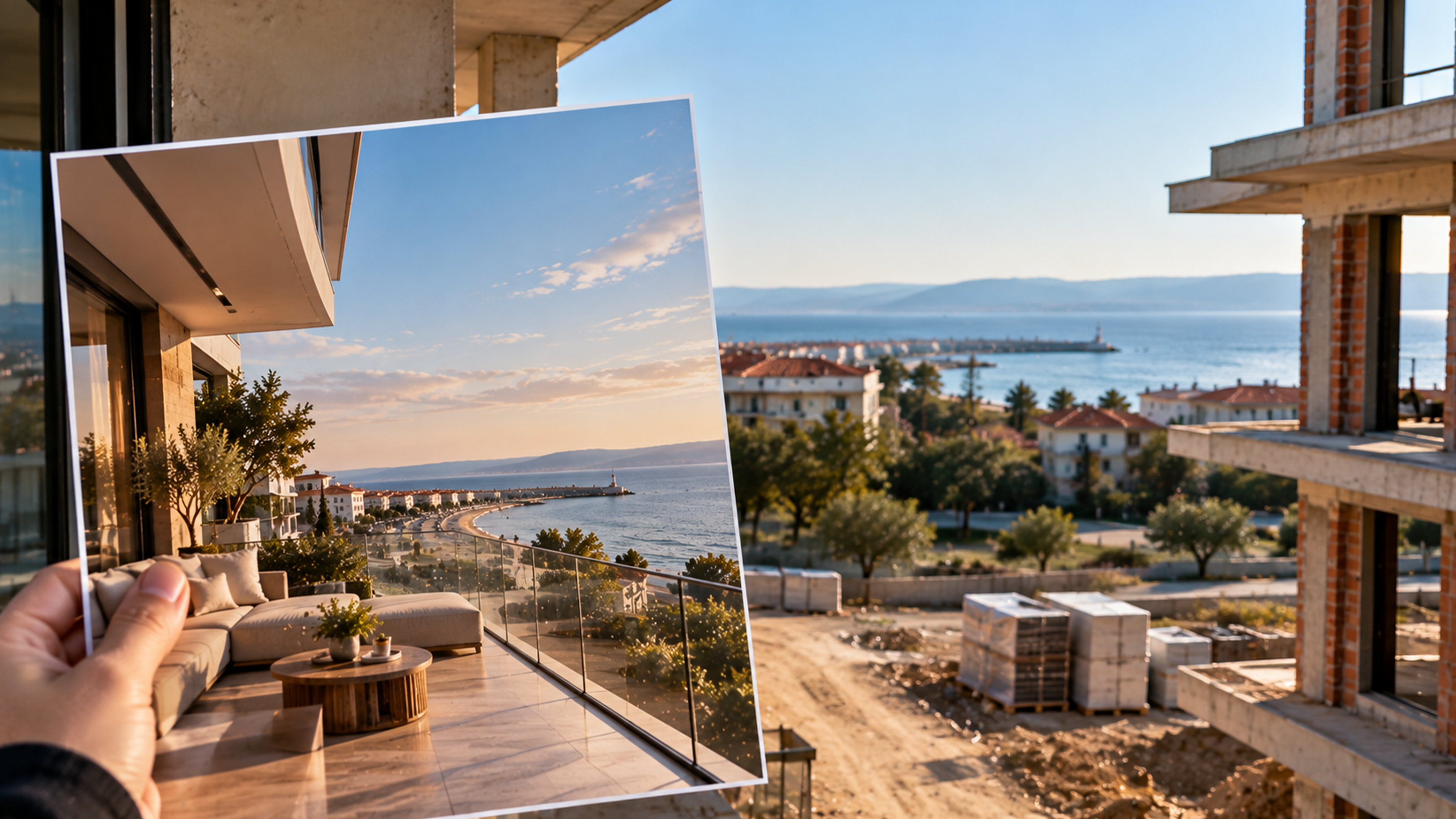

Property advertising has one goal: to make you pick up the phone. That is why it always talks about the best price, the most beautiful view and the most optimistic timeline. This is not deception in itself — but between the listing and the title deed, there is often a gap that buyers discover too late.
We have selected six promises that appear most frequently in property advertising. Find out what usually lies behind them and what to ask before you pay a deposit.
Promise 1: “Prices from €…/m²”
The word “from” is not a problem in itself — almost every developer uses it, including us. The problem arises when the buyer does not know exactly what it refers to.
Behind the lowest price in the listing, there are usually three things:
- The least attractive apartment in the building — a low floor, north-facing orientation or no view. The other units may be 10–20% more expensive.
- Price excluding VAT. For new-build properties sold by a VAT-registered company, 20% VAT is added to the price. On an apartment priced at €80,000, that is an additional €16,000.
- Price based on gross area. The price per square metre is multiplied by the total area including the proportional share of the building’s common areas — not just the space you will actually live in.
On top of this come the transaction costs, which listings rarely mention: the local property transfer tax (set by the municipality), notary fees and a registration fee of 0.1%.
What to ask: “What is the final price of this specific apartment including VAT?” and “What are all the additional costs up to receiving the title deed?”
Promise 2: “5 Minutes from the Beach” and “Sea View”
“Five minutes” is not a unit of measurement. It can mean 300 metres on foot — or five minutes by car outside of peak season. The same applies to “first line,” “by the sea” and “close to the centre.” These are all expressions without precise meaning.
The view claim is even more nuanced. Photos in listings are often taken from the top floor or with a drone, and a “partial sea view” can sometimes mean a strip of blue between two buildings. Furthermore, today’s view is not guaranteed tomorrow: if there is an undeveloped plot in front of the building, the planning regulations may allow a new building to appear there.
What to ask: “What is the walking distance to the beach in metres?”, “What exactly is the view from my specific apartment and floor?” and “What does the plan show for the neighbouring plots?”
At InterHomes, we state distances in metres whether it is 200 metres to the beach or 500. You can see the view for yourself through a live virtual tour from the specific apartment.
Promise 3: “Guaranteed Rental Yield”
This is perhaps the most attractive promise in the coastal property market — and the hardest to deliver on. Before placing your trust in it, break it down into its component parts.
Gross or net yield? Listings almost always quote gross yield. From that figure, you subtract management, cleaning, platform commissions, maintenance, utilities, taxes and furnishing costs.
At what occupancy rate? The calculation of “nightly rate × 120 days” assumes the apartment is occupied every single day throughout the entire season. In practice, there are empty days, slow weeks and months outside the season.
Who guarantees it and on what basis? “Guaranteed” only means something if it is written into a contract — with a specific sum, a timeframe and an accountable party.
For context: market analyses for Bulgaria point to an annual rental yield of around 4–5%, and hidden costs combined with vacancy periods are the main trap in this type of investment. Promises of a “secure” yield twice that level deserve detailed questions.
Pomorie has real tourist demand — 528,660 overnight stays for the 2025 summer season. But demand is concentrated in a few months, and no honest seller can guarantee you a specific occupancy rate.
What to ask: “Is this gross or net yield, and at what occupancy rate has it been calculated?” and “Is it written into the contract and who bears responsibility if it is not achieved?”
Promise 4: “Act 16 by the End of the Year”
The timeline in the advertisement and the timeline in the contract are two different things. The first is an intention; the second is an obligation. When buying off-plan, only the second one matters.
Delays in obtaining the permit to use a building are not uncommon — and they do not always depend on the developer, as the procedures pass through several institutions. For this reason, the more important question is not “When?” but “What happens if it doesn’t happen on time?” In practice, there have been more serious cases: in 2025, the press reported on a construction company that unilaterally terminated preliminary contracts for nearly-completed apartments and returned buyers’ money without interest after three years.
Check the preliminary contract for the following:
- Is there a specific date for Act 16 and for handover of the apartment?
- What penalty does the developer owe in the event of a delay, and from which date does it start running?
- How much time can the developer extend the deadline without consequences?
- Under what conditions can either party terminate the contract?
What to ask: “What stage is the building at today and what date is written into the contract?” and “What is the penalty for delay?”
For InterHomes IV, we say that Act 16 is expected in September 2027 — “expected,” not “guaranteed,” because that is the honest formulation while the building is still under construction. InterHomes I has already received its Act 16.
Promise 5: “Luxury Finish” and “Turn-Key”
These expressions have no legal definition. “Turn-key” for one developer means a fully finished bathroom, flooring and interior doors — for another, it means plasterwork and floor screed. “Luxury” means nothing specific.
Visualisations add further confusion. They show a furnished apartment with a fitted kitchen, lighting and air conditioning units — which are almost never included in the price. The same applies to the parking space and storage room: in the advertisement the complex comes “with parking,” but the space is purchased separately.
What to ask: “Can I receive a written specification of the finishing works — including materials, brands and exactly what is included?” and “Are the parking space and storage room included in the price?”
The specification must be an appendix to the contract. If it only exists in the brochure, you have no legal basis to rely on it.
Promise 6: “Last Remaining Apartments” and “Offer Valid Until the End of the Month”
Artificial urgency is one of the oldest techniques in sales. Sometimes it is true that three apartments are left. Sometimes those same “last three” have been sitting in the listing for six months.
The Consumer Protection Act defines as an unfair practice any false claim that an offer is available only for a very limited time, when the purpose is to deprive you of the opportunity to make an informed choice. A property purchase involves tens of thousands of euros — no honest transaction cannot wait a few days for you to review the contract with a lawyer.
This category also includes listings marked “no buyer’s commission.” This usually means the commission is paid by the seller and is built into the price.
What to ask: “Can I see the current list of available apartments and their prices?” and “Can I take the draft contract away to review it at my own pace?”
How Do You Tell Honest Advertising from Misleading Advertising?
The rule is simple: every promise made in the advertisement must be capable of being written into the contract. If the seller is prepared to put it in writing with numbers, dates and accountability, the promise is real. If they start explaining why “that sort of thing doesn’t get written down,” you already have your answer.
It is also worth knowing that misleading commercial practices are prohibited under the Consumer Protection Act — including the withholding of material information such as the final price inclusive of taxes. But the best protection remains your own due diligence before signing, not a complaint filed afterwards.
At InterHomes, we prefer to promise less in the advertising and deliver everything in the contract. We state distances in metres, timelines as expected while the building is under construction, and the annual maintenance fee at the exact figure: €150 excluding VAT. We do not promise guaranteed rental yields, because that is not within our control — but we are happy to walk you through the real numbers for Pomorie so you can do the calculation yourself.
If you are considering buying an apartment in Pomorie, put every question from this article to us — you will receive specific answers, not advertising copy.
Explore the apartments at InterHomes and contact us for a free consultation.
Read also our article “5 Questions Almost Nobody Asks Before Buying an Apartment — But Should!”